The Klamas Family in Paraná
The arrival in Brazil
In December 1876 the ship Kepler arrived in Paranaguá, via Rio de Janeiro, coming from the port of Antwerp, carrying on board Valentin Klamas, 19, farmer, with his mother Bárbara Klamas (50) and his brother Josef Klamas (16) — all German Catholic citizens, from Rakowitz, province of Marienwerder, West Prussia, bound for Curitiba.
Source: Records of entry of foreigners in Brazil, National Archives of Rio de Janeiro.
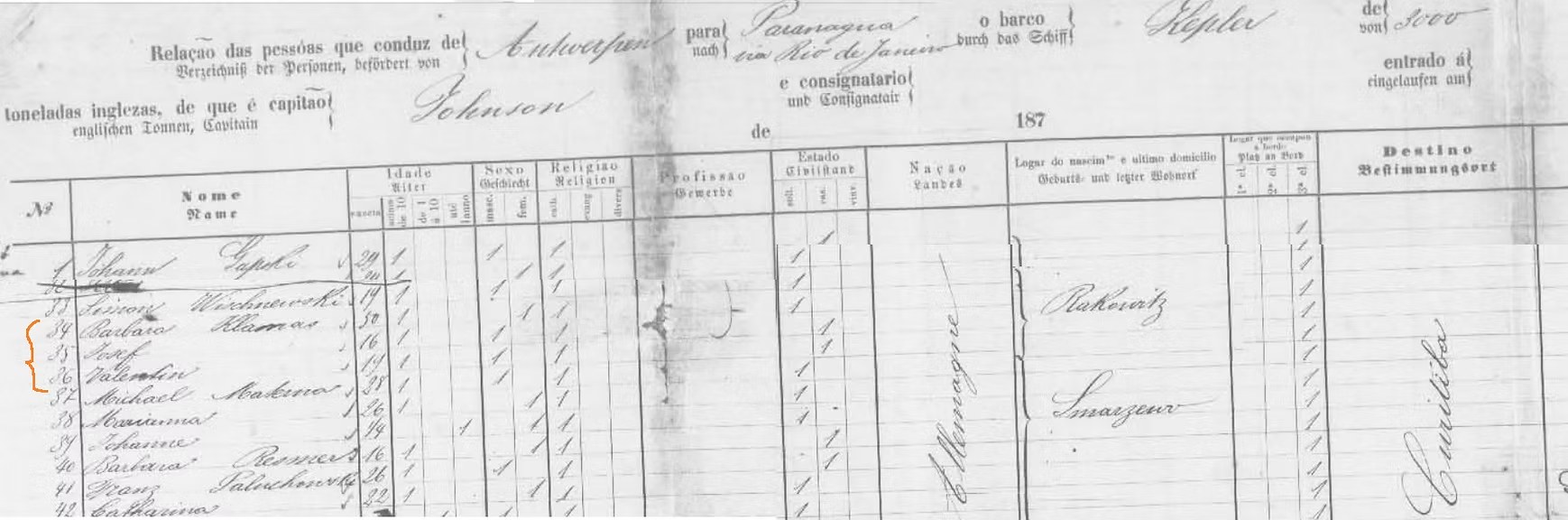
Passenger list of the ship Kepler, 11.12.1876 — the names of Barbara Klamas (no. 34), Josef (no. 35) and Valentin (no. 36) are visible, with origin in Rakowitz and destination Curitiba. National Archives of Rio de Janeiro.
From Paranaguá, Valentin and his family climbed the mountain range towards Curitiba and settled temporarily in the Abranches colony with other Polish settlers. Although their citizenship is recorded as German, I believe they were of Polish ethnicity — based on oral tradition and the evidence, having integrated into Curitiba's Polish community.
At the end of the eighteenth century the Partitions of Poland took place, when it was divided between the Kingdom of Prussia, the Russian Empire and the Austro-Hungarian Empire. Rakowitz fell to Prussia — hence the German citizenship on the ship's manifest.
Plot No. 8 — Rivière Colony
Almost a year after his arrival, Valentin settled on plot number 8 of the Rivière Colony on 31.12.1877. At some point between 1877 and 1880, he married Lucia Kleina, probably in Abranches or Orleans — she came from Bielski, a neighbour of Rakowitz in Prussia. There is no further record of his mother Barbara. His brother Josef Klamas settled on plot no. 33 of the Santo Inácio Colony.
"Valentin Klamas, 28 years old, married, Polish, farmer, settled on plot number 8 of the Rivière Colony on 31.12.1877. Grows rye, maize, beans, potatoes, peas, and owns a wooden house, one barn, one stable, two horses and one cow. Wife Lúcia Klamas, 26, Polish. Children: Leocádia (6), Júlio (2) and Francisco (1)."
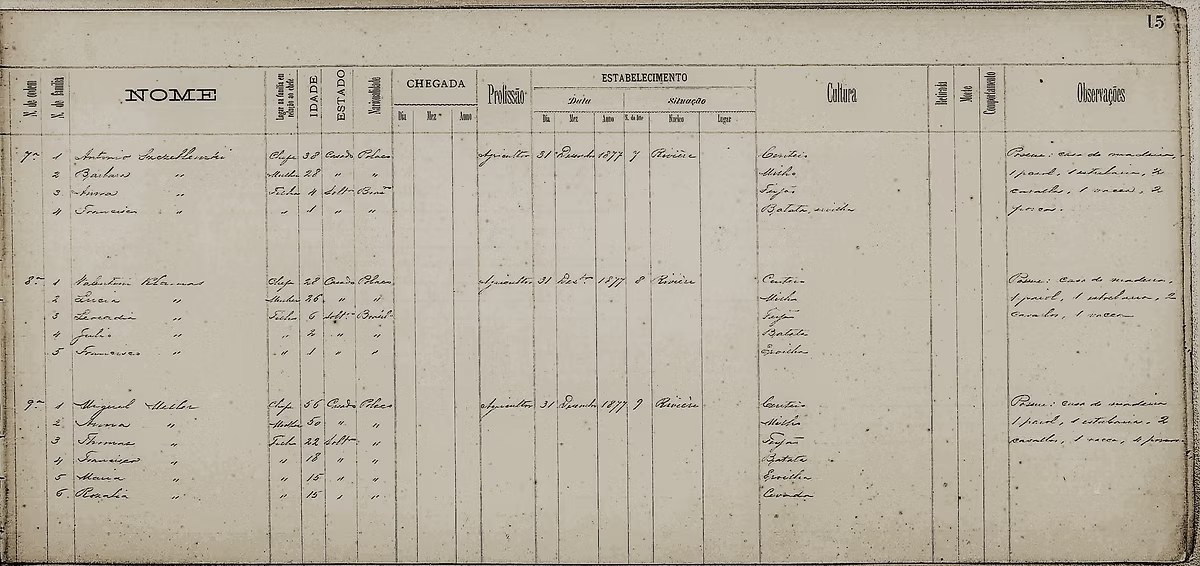
Statistics of residents of the Curitiba Colonies, 1887 — entry of the Klamas family, plot number 8, Rivière Colony.
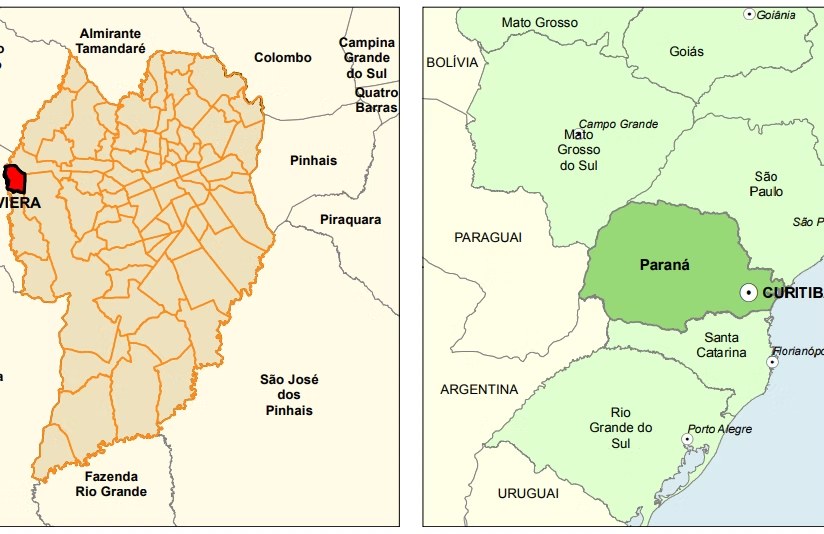
Location of plot no. 8 — 19,250 m² — of the Klamas family in the Rivière Colony, Curitiba.
On 07.10.1889, Valentim Klamas presented himself in Curitiba to take the oath of allegiance to the Constitution and laws of the Brazilian Empire, thus acknowledging Brazil as his homeland. On 28.06.1898, Valentim Klamas transferred his plot in the Rivière Colony to João Maczonek, probably the occasion on which he moved with his family to the Thomaz Coelho Colony, in Araucária.
The occupation of southern Brazil
According to the Bull Inter Coetera of Pope Alexander VI, in 1493, the lands discovered or to be discovered beyond a meridian 100 leagues west of the Azores and Cape Verde islands would belong to Spain. With the Treaty of Tordesillas (1494), Portugal was granted the lands situated east of the imaginary line marking 370 leagues west of the Cape Verde islands.
With these treaties in force, southern Brazil belonged to Spain. Disagreements began with the discovery of new islands in the Cape Verde archipelago — in the Spanish understanding, the line passed through the Airiri bar in Cananéia-SP; in the Portuguese version, in Laguna-SC.
After two centuries of occupation and colonisation by the Spanish in the República del Guaíra (present-day state of Paraná), invaded and pillaged by the São Paulo Bandeirantes, Spain ceded the territory up to the Colônia do Sacramento in Uruguay with the Treaty of Madrid in 1750.
The reasons that encouraged immigration
Until the early eighteenth century, only the Portuguese were authorised to settle in the Colony. After the arrival of the Court in 1808, an immigration policy supported by Dom João was implemented, with specific legislation. The main reasons were:
On the Brazilian side: the occupation and colonisation of the territory, the need to supplement enslaved labour, promote subsistence agriculture and provide workers for the construction of large public works.
On the European side — mainly Germany, Italy and Poland — the countries went through economic and agrarian crises and constant wars in the nineteenth century, producing a large contingent of emigrants.
In the specific case of the Province of Paraná, only emancipated in 1853, incentives for land ownership were granted together with the imperial government. The Province's first president, Zacarias de Góes e Vasconcelos (1853–1855), saw as the initial challenge: "populating this territory of two hundred thousand square kilometres", and enacted laws to promote the immigration of foreigners.
Linism and the colonisation of Paraná
It was under the administration of Adolfo Lamenha Lins that the colonisation of Paraná gained great momentum — with a new colonisation system, different from the models already organised in the province and even elsewhere in Brazil. Its principles were based on:
- Telling the immigrant the truth about the new homeland, avoiding exaggerated promises;
- Facilitating transport, avoiding hardship and mistreatment during the journey;
- Dividing good plots of land near populous centres, accessible by roads;
- Making the settler commit to the land they inhabit through property rights, facilitating its acquisition;
- Preventing the immigrant from suffering hardships upon arrival in unknown regions;
- Settling the colonist properly with the promised favours and then freeing them from any tutelage, leaving them to the development of their own initiative.
This system became known as Linism. In the relatively short period of his administration, Lamenha Lins founded the colonies of Santa Cândida, Orleans, Dom Pedro, Dom Augusto, Tomás Coelho, Lamenha Grande, Lamenha Pequena, Santo Inácio and Rivière — creating the "green belt" for supplying Curitiba.