From Prussia
to Paraná
Valentin Klamas · Rakowitz, Marienwerder · Arrival in Brazil, 1876
A brief history of Prussia and Pomerania
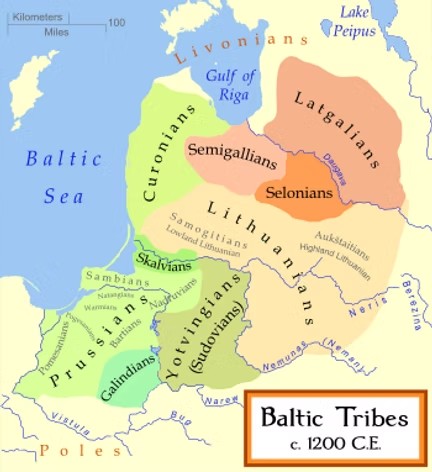
Prussia was a historical region that stretched from northern Germany to Lithuania. The name Prussia originated from the Prussians, a Baltic people who inhabited the area between the Latvian lagoons and the Vistula River — in what is now northern Poland.
In the thirteenth century, the pagan Prussians were gradually subdued by the Teutonic Order, invited by the Polish duke Conrad of Mazovia to christianise and pacify the region beyond the Vistula. The knights were guaranteed possession of the lands to be conquered, a guarantee obtained from Pope Gregory IX in 1234. By the end of the thirteenth century, what remained of the Prussians was subject to the Germans.
Before the end of the seventeenth century, the Prussian language had died out. The culture of the Prussians was Germanised — or Polonised, depending on which part of Prussia they inhabited.
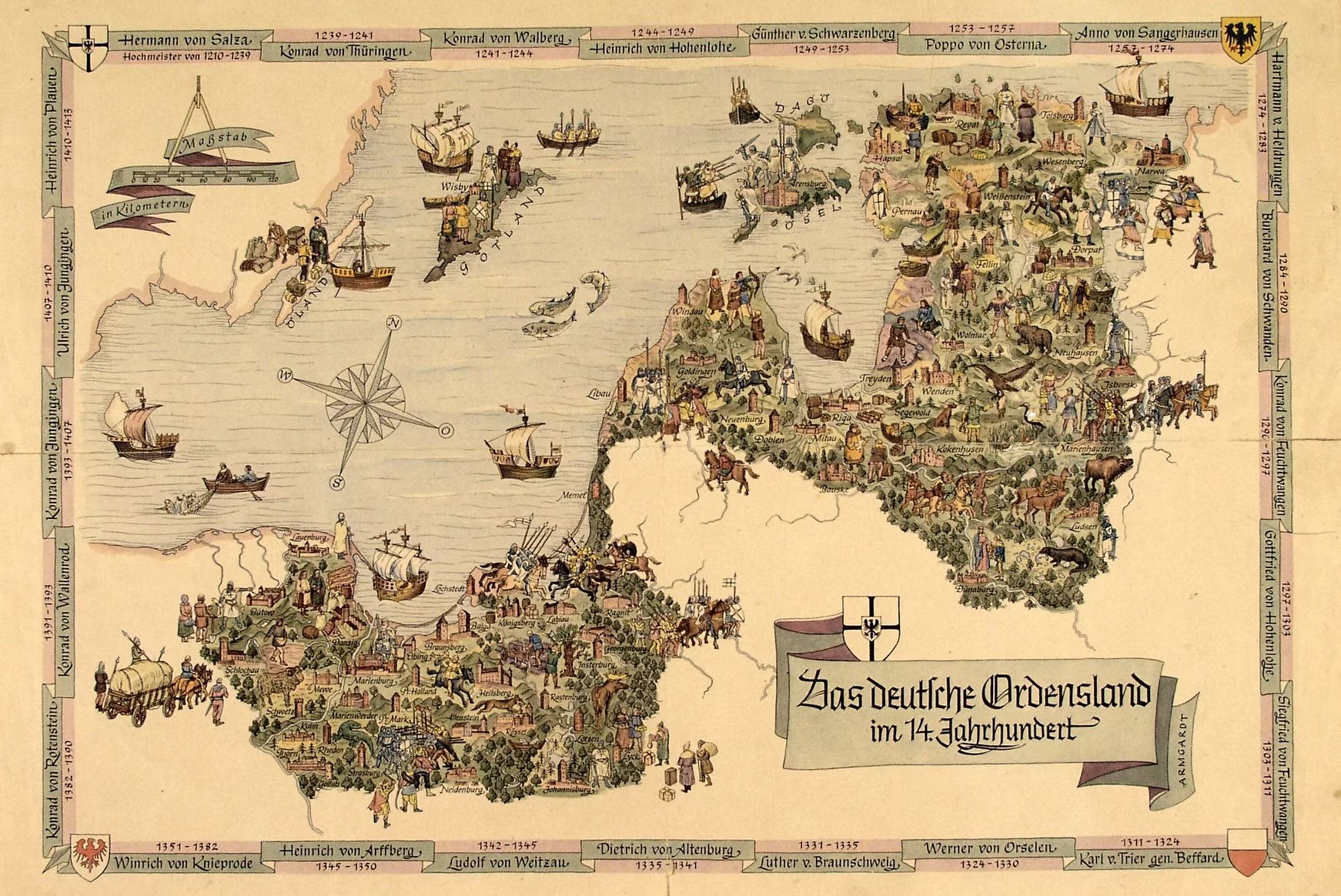
The territory of the Teutonic Order in the fourteenth century — Das deutsche Ordensland im 14. Jahrhundert. Marienwerder (Kwidzyn), the town near Rakowitz, appears marked in the south-central part of the map.
The region developed westward until, in the nineteenth century, Otto von Bismarck managed to unite the Germanic peoples into a single state, creating the German state. Part of Prussia was lost to Poland after the Second World War.
In 1876 Valentin Klamas arrived in Curitiba with his mother Barbara and his brother Josef Klamas, from Rakowitz, Marienwerder, West Prussia — about 80 km south of Danzig.
Rakowitz — the family's origin in the Old World
Rakowitz — today known as Piaseczno, in Poland — was a small locality situated in the region of Marienwerder, West Prussia, about 80 kilometres south of Danzig (present-day Gdańsk). It was a region of agricultural plains crossed by the Vistula River, with a deeply rooted Germanic tradition and a strong Lutheran presence.
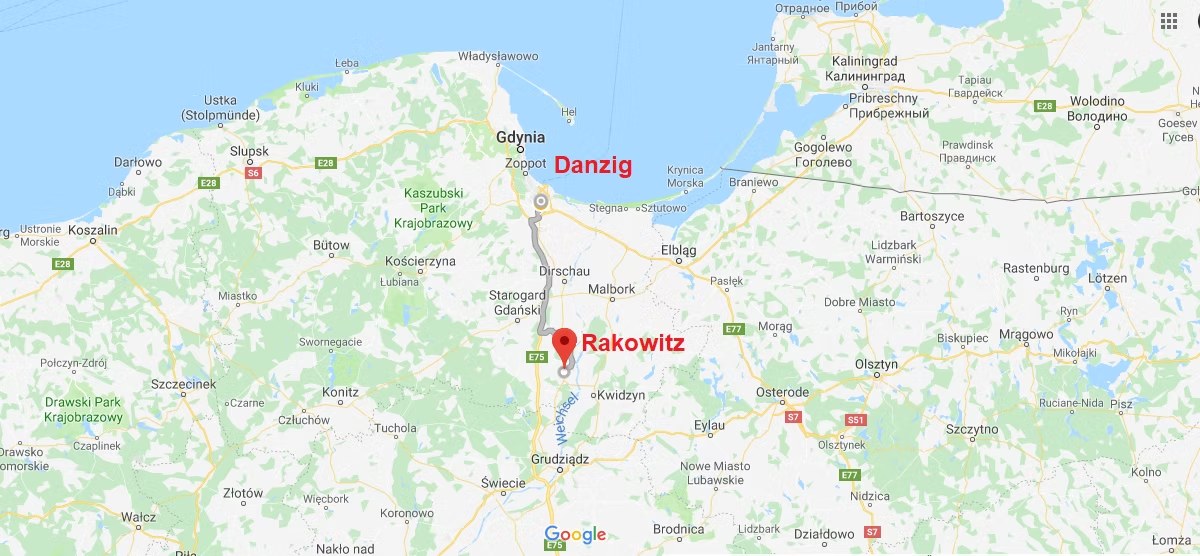
Rakowitz (today Piaseczno, gmina Gniew) is located about 80 km south of Danzig, on the bank of the Vistula — the Marienwerder region, today in northern Poland.
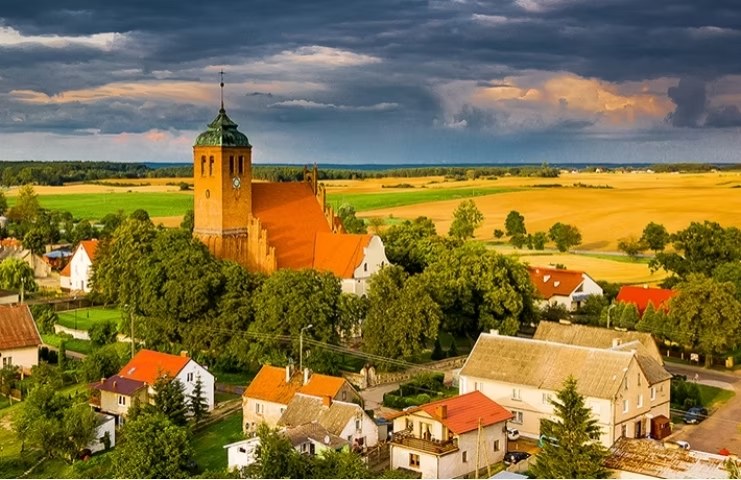
Aerial view of Rakowitz (today Piaseczno, gmina Gniew) — the locality and its medieval church amid the plains of the former Marienwerder. It was from this village that Valentin Klamas, his mother Barbara and his brother Josef set out in 1876.
The occupation of land in southern Brazil
By the Bull Inter Coetera of Pope Alexander VI, in 1493, the lands discovered beyond a meridian 100 leagues west of the Azores and Cape Verde islands would belong to Spain. The Treaty of Tordesillas, signed in 1494, adjusted this line to 370 leagues west of Cape Verde, granting Portugal the lands to the east. As a result, southern Brazil belonged, in practice, to Spain — a situation that lasted until the advance of the São Paulo Bandeirantes and the Treaty of Madrid of 1750.
The reasons that encouraged immigration
Until the early eighteenth century, only the Portuguese were authorised to settle in the Colony. After the arrival of the Court in 1808, an immigration policy supported by Dom João was implemented, with specific legislation. Broadly speaking, the main reasons were:
- On the Brazilian side: the occupation and colonisation of the territory, the need to supplement enslaved labour and provide workers for the construction of large public works.
- On the European side — mainly Germany, Italy and Poland: economic and agrarian crises, and constant wars that produced a large contingent of emigrants.
In the specific case of the Province of Paraná, only emancipated in 1853, incentives for land ownership were granted together with the imperial government. The Province's first president, Zacarias de Góes e Vasconcelos (1853–1855), saw as the administration's initial challenge to "populate this territory of two hundred thousand square kilometres" and enacted laws to promote the immigration of foreigners.
Linism and the colonisation of Paraná
But it was under the administration of Adolfo Lamenha Lins that the colonisation of Paraná gained great momentum — with a new system that differed from the models already organised in the Province and the rest of Brazil. Its principles were based on:
- Telling the immigrant the truth about the new homeland they seek, instead of poetic descriptions and exaggerated promises.
- Facilitating their transport, preventing the immigrant from suffering hardship and mistreatment until the end of their journey.
- Dividing good plots of land near populous centres and making them accessible by roads.
- Making the settler commit to the land they inhabit, through property rights, facilitating its acquisition.
- Preventing the immigrant, upon arrival, from suffering hardships that would dishearten them in their first steps in unknown regions.
- Settling the colonist properly, with all the promised favours, and then freeing them from any tutelage, leaving them to their own devices and to the development of their own initiative.
This system became known as Linism. In the relatively short period of his administration at the head of the government of the Province of Paraná, Lamenha Lins founded the colonies of Santa Cândida, Orleans, Dom Pedro, Dom Augusto, Tomás Coelho, Lamenha Grande, Lamenha Pequena, Santo Inácio and Riviere — creating the "green belt" for supplying Curitiba. It was in this context that Valentin Klamas and his family arrived in Brazil in 1876.
The arrival in Paraná
In December 1876 the ship Kepler arrived in Paranaguá, via Rio de Janeiro, coming from the port of Antwerp, carrying on board Valentin Klamas, 19, farmer, with his mother Bárbara Klamas (50) and his brother Josef Klamas (16). All German Catholic citizens, from Rakowitz, province of Marienwerder, West Prussia, bound for Curitiba.
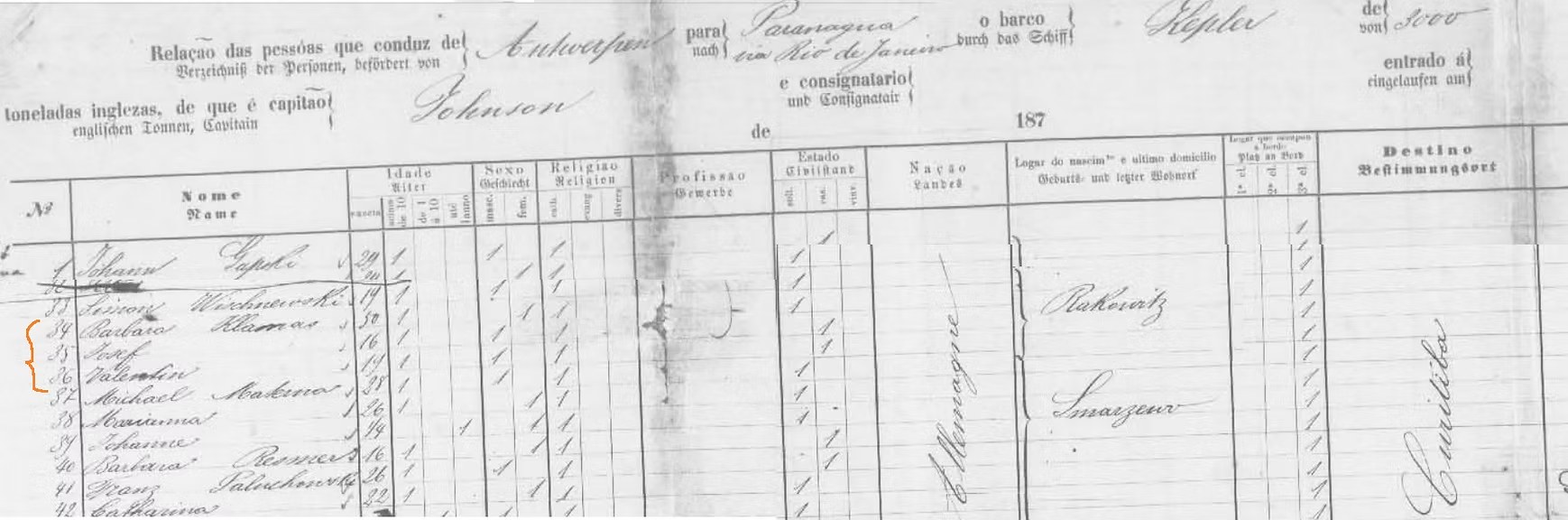
Passenger list of the ship Kepler, 11.12.1876 — the names of Barbara Klamas (no. 34), Josef (no. 35) and Valentin (no. 36) are visible, with origin in Rakowitz and destination Curitiba. Source: Records of entry of foreigners in Brazil, National Archives of Rio de Janeiro.
From Paranaguá, Valentin and his family climbed the mountain range towards Curitiba and settled temporarily in the Abranches Colony, with other Polish settlers. Although their citizenship is recorded as German, they are believed to have been of Polish ethnicity — a hypothesis reinforced by oral tradition and their immediate integration into Curitiba's Polish community. At the end of the eighteenth century the Partitions of Poland took place, when it was divided between the Kingdom of Prussia, the Russian Empire and the Austro-Hungarian Empire, with Rakowitz falling to Prussia.
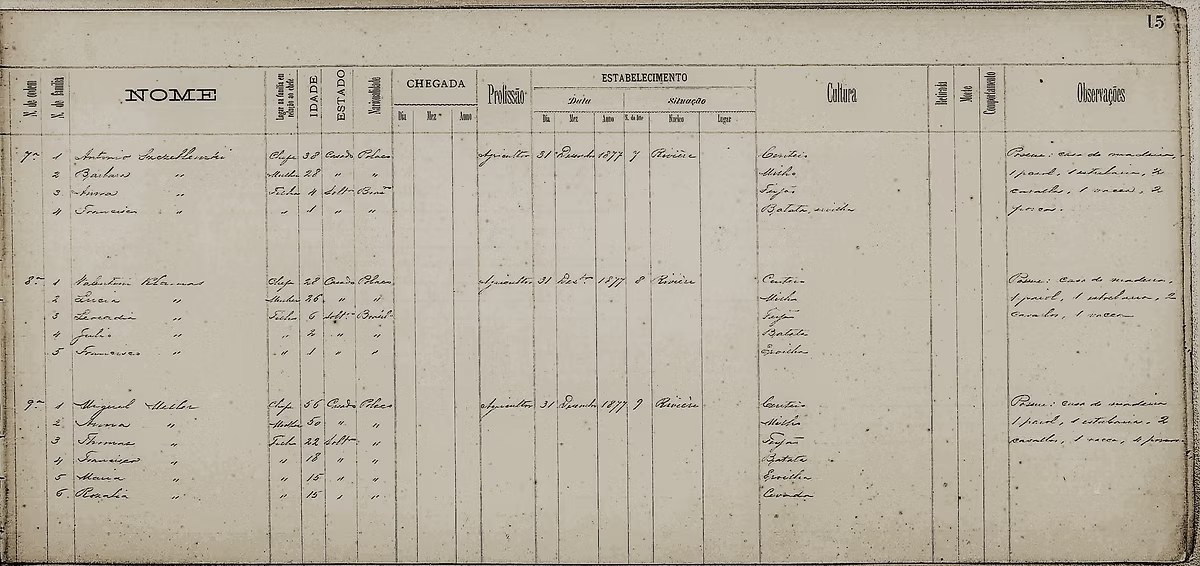
Statistics of the Curitiba Colonies, 1887 — Valentin Klamas (no. 8), farmer, plot no. 8 of the Rivière Colony, settled on 31.12.1877. Wife Lúcia Klamas, 26; children Leocádia (6), Júlio (2) and Francisco (1). Crops: rye, maize, beans, potatoes, peas. Owns a wooden house, one barn, one stable, two horses and one cow.
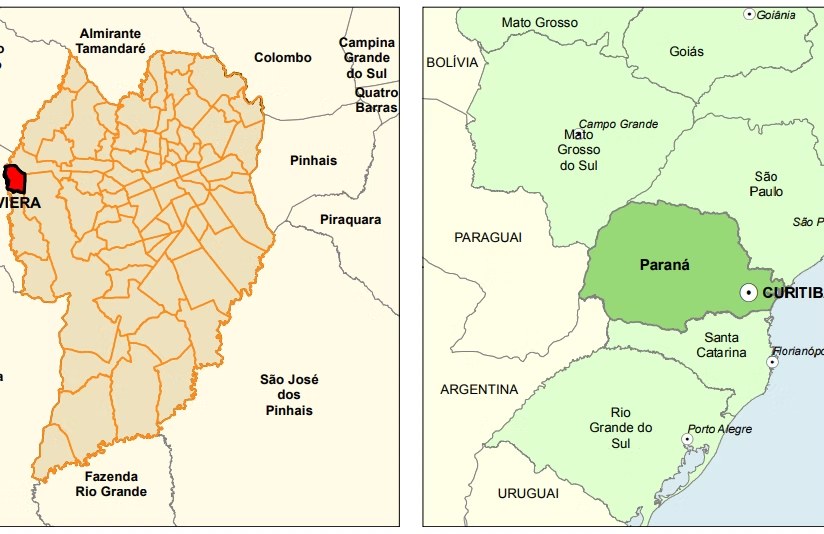
Location of the Rivière Colony (in red) in the metropolitan region of Curitiba — where Valentin Klamas settled plot no. 8 on 31 December 1877.
On 07.10.1889, Valentin Klamas presented himself in Curitiba to take the oath of allegiance to the Constitution and laws of the Brazilian Empire, thus acknowledging Brazil as his homeland. On 28.06.1898, he transferred the plot in the Rivière Colony to João Maczonek — probably the occasion on which he moved with his family to the Thomaz Coelho Colony, in Araucária.