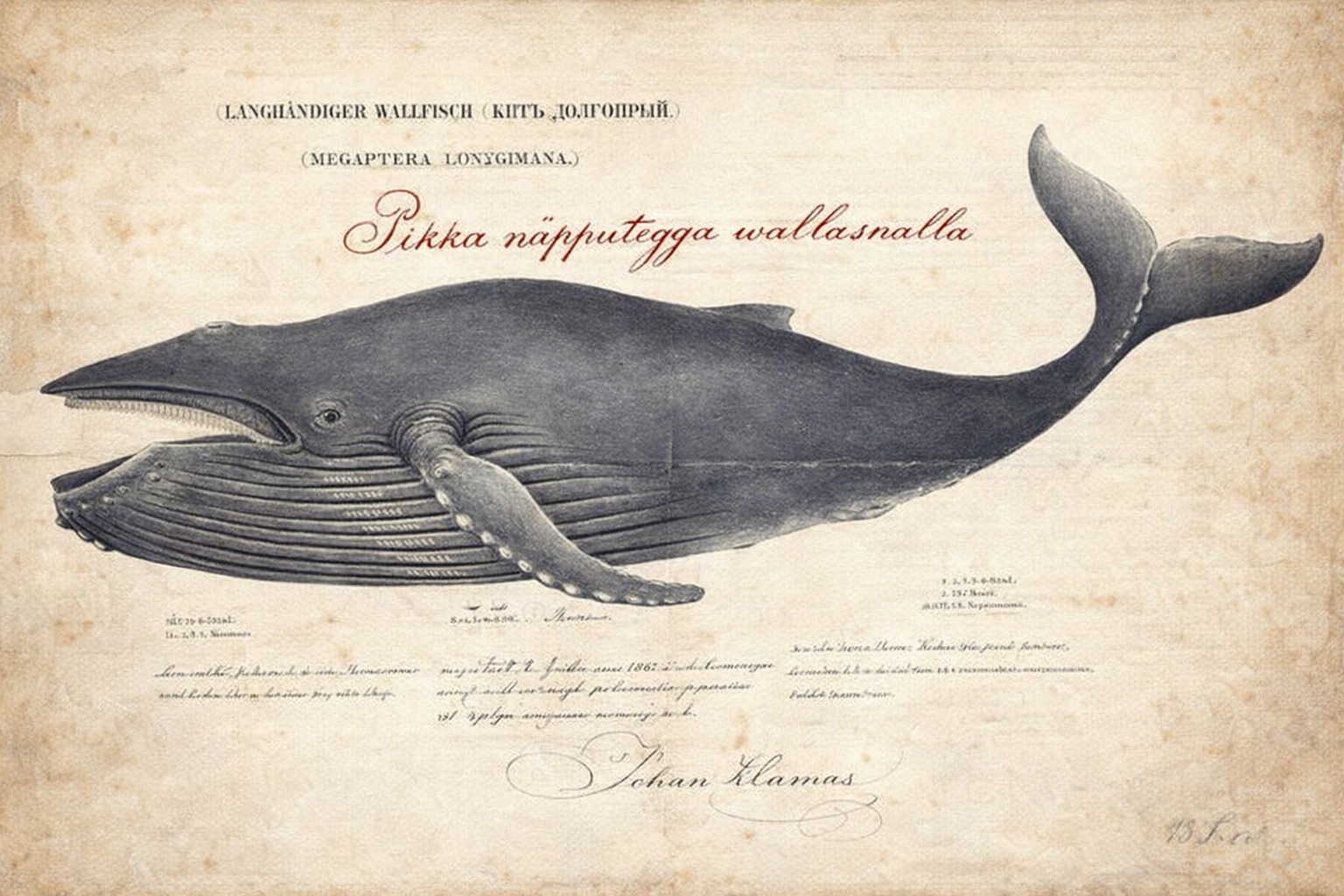
Lorenz Heinrich Petersen — Küürvaal (Humpback Whale) · Lithograph · Tallinn, 1851 · Printer: Friedrich Wilhelm Macdonald · Inscription in archaic Estonian: «Pikka näpputegga wallasnalla» ("great whale displayed to the public") · Handwritten signature: Johan Klamas
§ 1 — Article · Rammu Island · Estonia, 1851
The Rammu Whale and the Baltic Klamas
The stranding of a humpback whale in 1851 and the transformation of an island family
In April 1851, a singular event interrupted the harsh routine of the islanders of Rammu and forever inscribed the Klamas name in the memory of the Gulf of Finland archipelago. On 9 April, after a storm on the Baltic Sea, a humpback whale (Megaptera novaeangliae) ran aground dead on the small islet of Allu, adjacent to Rammu. The animal measured approximately 9.68 metres in length and weighed more than ten tonnes.
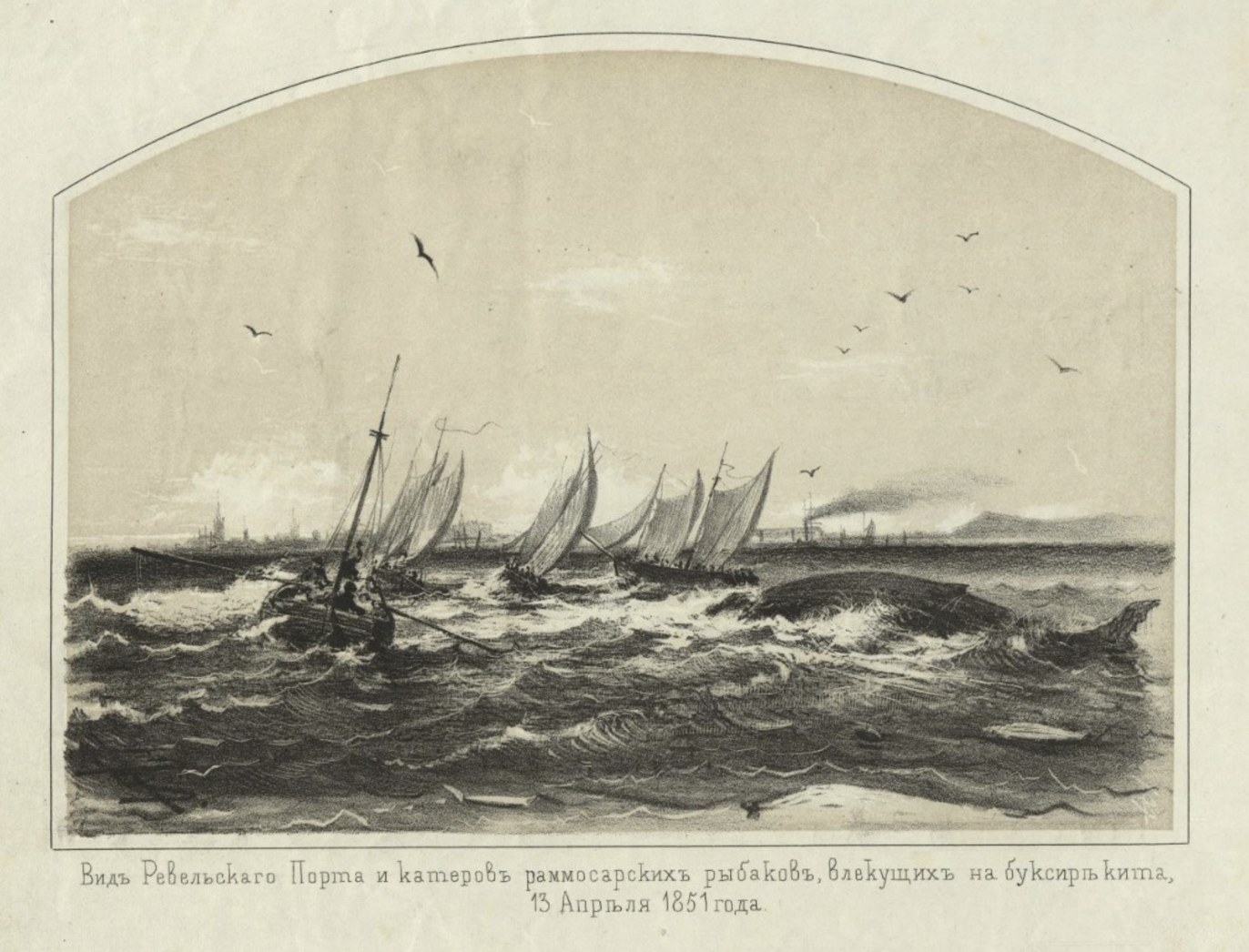
According to oral tradition and the parish records of Jõelähtme, members of the Klamas family were the first to spot the animal. As island residents, local families held the right to resources that washed ashore. The recovery and transport of the carcass to Tallinn was then organised, using two sailboats. At the port, the whale was displayed to the public for a fee, quickly becoming an event of great scientific and popular interest.
The inhabitants also attempted to extract fat from the animal to produce whale oil. However, accounts from the period indicate that the resulting odour was extremely intense, reaching as far as the neighbouring islands, which ultimately limited this practice.
The carcass was subsequently acquired by the St. Petersburg Academy of Sciences for 850 roubles — an exceptional sum for the time and for a community of that size. The transaction was mediated by the naturalist Karl Ernst von Baer, a central figure in nineteenth-century Russian science and a pioneer of modern embryology. The specimen was prepared under scientific supervision, transported and mounted in St. Petersburg for osteological study and public education. Estonian sources indicate that the skeleton remains preserved to this day, possibly at the Zoological Museum of the Zoological Institute of the Russian Academy of Sciences.
The economic impact was profound and immediate. The sum received was distributed among the island's families, with the Klamas and the Lambot, who led the entire operation, standing out. With these resources, the inhabitants acquired modern fishing nets and larger boats, beginning to operate in more distant waters and expanding trade with Tallinn and Helsinki. There were also improvements in housing — the construction of sturdier wooden houses on stone foundations — and greater access to education for the following generations.
The episode became a permanent part of the island's identity. In the literature of August Mälk, an Estonian writer who portrayed the life of coastal communities, the event is interpreted as a rare moment when the sea, normally hostile and stingy, brought unexpected prosperity. The whale altered the regional social hierarchy and generated respect — and envy — from neighbouring communities, who came to nickname the inhabitants of Rammu «whale hunters», even though they had not actually hunted the animal.
The event was recorded in scientific lithographs. Notable among them is the work of Lorenz Heinrich Petersen, produced in Tallinn and printed by Friedrich Wilhelm Macdonald. Some prints bear inscriptions in archaic Estonian — «Pikka näpputegga wallasnalla», "great whale displayed to the public" — as well as annotations in Latin and scientific Russian. On certain copies, the handwritten signature Johan Klamas appears, suggesting a direct connection to the family that organised the rescue, although this association has not been formally proven.
View of the Port of Reval and the boats of Rammu fishermen towing the whale · 13 April 1851 · Lithograph, St. Petersburg, c. 1851 · Inscription in Russian: «Вид Ревельского Порта и катеров раммосарских рыбаков, влекущих на буксирѣ кита»
Later oral traditions mention dimensions of 20 to 22 metres for the animal, possibly due to exaggeration over the generations or taxonomic confusion. The documented measurement is 9.68 metres — still an impressively sized animal for those who had never seen anything similar in Baltic waters.